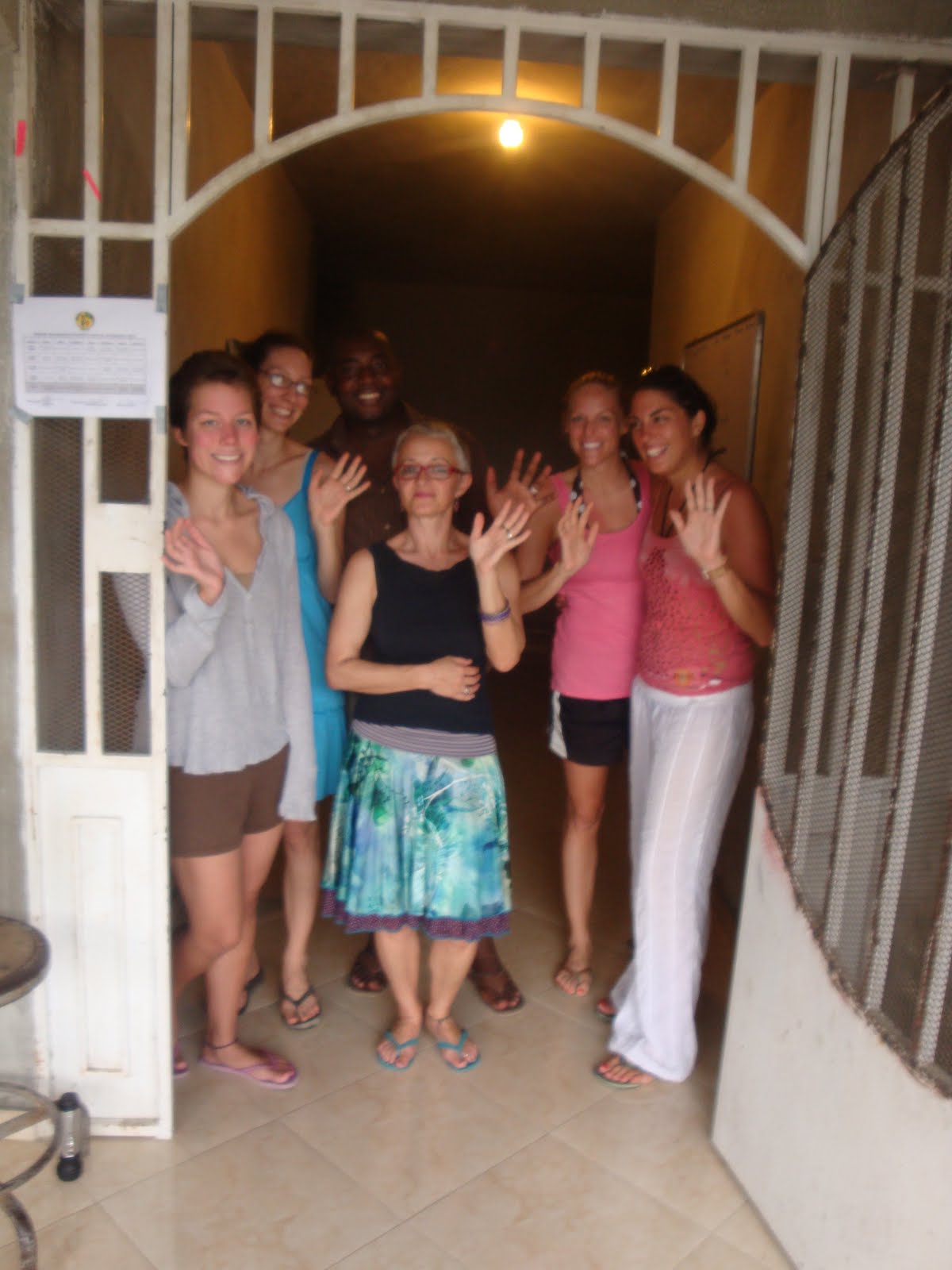
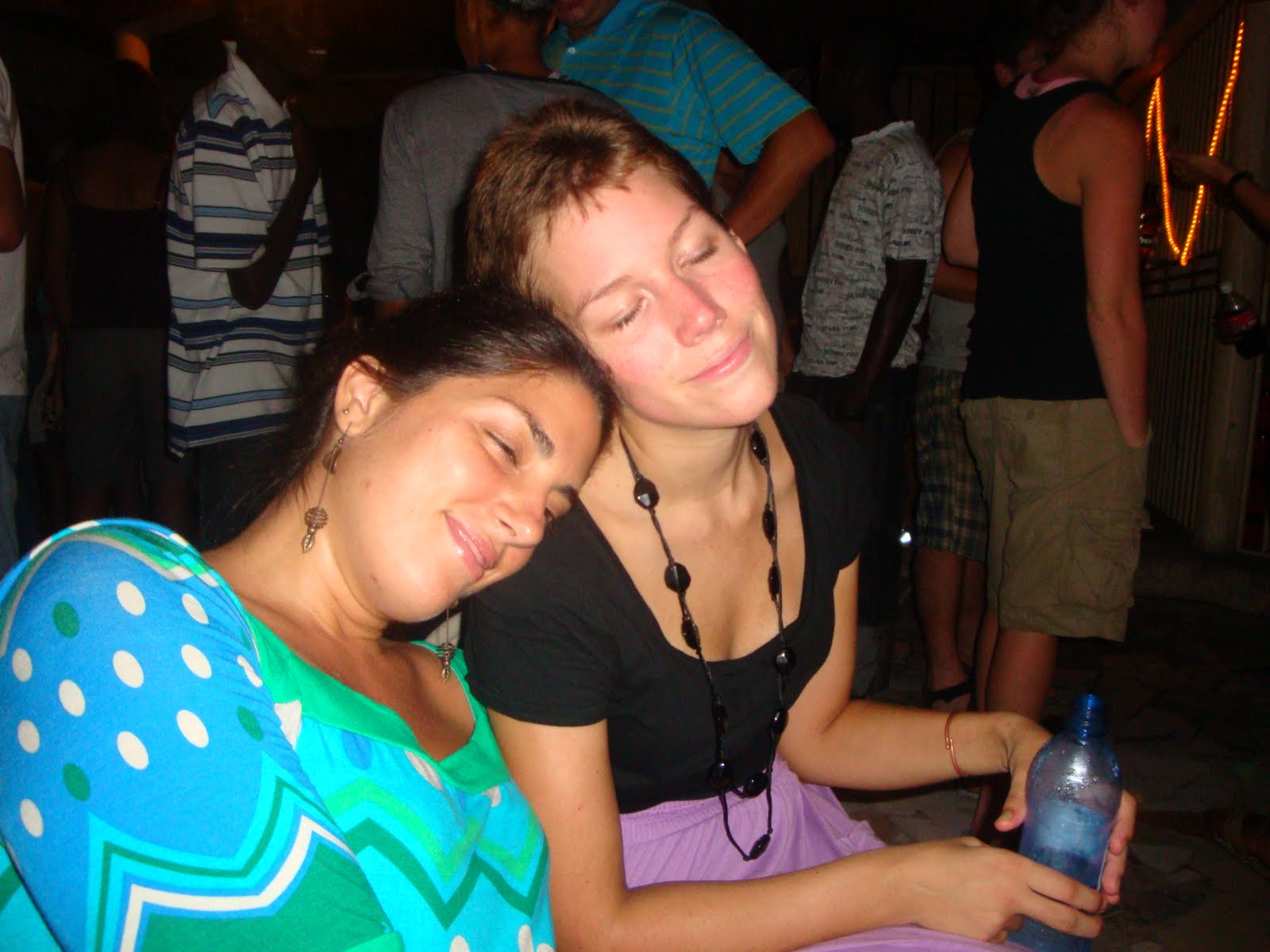
I wanted you all to meet the other expats that I live with here in Leogane, so you can put a face to the names I keep talking about. First, meet the new CNP Country Director, Katherine Goulliart (we all call her Kat). She is a nurse midwife with years of experience here in Haiti. She worked at CNP as the maternal and newborn care coordinator before becoming the Country Director. She has a fascinating life story - from being a French Australian, to performing in the circus to living in refugee camps in Vietnam, there isn't much she has not done in her life. She has more energy than anyone I know. There isn't a day that goes by where we don't hear her laughing hysterically.
 Next, meet my friend Kara Telesmanick. Kara has worked for CNP for over 3 years. She is the Program Manager and has devoted so much time and effort to CNP, and has done tremendous work, especially following the earthquake. Before coming to CNP she did Peace Corps and lived in Bangladesh and also worked in South Africa. Kara is a vegan who is obsessed with dogs like me (her two Haitian dogs are now living with her parents in the states). She is an amazing dancer and is rarely found sitting down on our nights out dancing because all of the guys want to dance with her. Kara is laid back and easy to talk to, but also is totally fun to have around. I am going to miss her so much when she leaves to go to Medical School in December!!!
 Meet Guesly Pierre. I have known Guesly since I started coming to Haiti in the summer of 2008 when he and Kara taught me dance lessons. You can always find Guesly singing and laughing. He just completed law school here in Haiti before the earthquake and has worked for Save the Children leading relief efforts after the earthquake.
Kara and Guesly are now married! They were married in June of this year here in Leogane. They are amazing together and it is so great to have them here in the house.

 Courtney Latta is a graduate of Elon who has worked for CNP for a year and a half. She is amazing and volunteered her time working as an intern before the earthquake and came back the earthquake to complete her internship. As of October 1st, she is officially an employee of CNP! She conducted all of the training sessions for the new monitrices (community nutrition workers) this summer and is going to be writing a training manual for our PD Hearth program.
  There is never a dull moment with Courtney around. She provides constant entertainment and is always telling the most ridiculous stories. She has had more near death experiences than anyone else I know . She has been struck by lightning, almost drowned when she went into SVT while playing drowning victim in her lifeguarding class, and had a showdown with a King Cobra in Zambia. We never know what will come out of her mouth next, especially when she starts a story, "This one time when I...." Courtney also loves to laugh and she may or may not snort when she laughs. We are working on breaking her Haiti record of 8 snorts in a row..
..
I should also mention that Courtney is a very kind, understanding, and generous person. Courtney is also my roommate and has a lot of patience to be able to put up with me. Next, meet my other boss, Michael Ritter. Michael and I both went to Emory for our MPH. He has been working here in Haiti for 2 1/2 years with household point of use water treatment programs. Gadyen Dlo was originally started by CNP, but Michael took over the program following the earthquake and has expanded it tremendously. Michael speaks amazing Kreyol and his Haitian staff loves working for him. He is always coming up with amazing and innovative ideas and is an extremely hard worker.
 Michael is also super laid back and has a lot of patience -. I don't know how he manages to live in this house of mostly girls. He is totally a trooper (but I think he secretly enjoys being surrounded by us girls, even when we give him a really hard time....).
 Elisa Marino is the Program Coordinator. She came to Haiti as a volunteer and was able to take over for the former CNP employee who was running the Stabilization Center. Elisa is a registered dietitian and has an MPH. She is meticulously organized and does a fabulous job running the Stabilization Center. We are all hoping that she will stay and take over Kara's position when Kara has to leave us in December.


Elisa is from the Southern part of Italy. She and I both love to cook, but Elisa is amazing at making bread. While it is a bit challenging with the humidity here, she has made us everything from pizza dough to olive bread to focaccia bread and totally spoils us. Elisa and I are both very strong-willed, outspoken, opinionated people, but we get along great and enjoy spending time together. Elisa is also a great friend who is a wonderful listener and I know there isn't anything she wouldn't do for us. She is always there when we need her.
Last but not least, meet Pierre Chackal (pictured on the far right). He just joined the CNP team a few weeks ago as our much needed Finance and Operations Manager. He came to us from Montreal. He and Kat previously worked together in Haiti. We are happy to have him on the team. For people who live and work in the same house, we all get along surprisingly well. I am very lucky to be surrounded by so many unique and amazing people!!! They all definitely make my time here even more special!
Many of you have asked what my living situation is like. I thought I would try and take you on a virtual tour of our house. Enjoy!
Approaching our house. You can see the walled/gated compound where we live on the left. The new signs for our programs that just went up last week.
 Welcome to our crib. Come on in!
The main hallway when you walk in the front door with our logistics board on the right. If you turn left at the end of the hallway, it leads to a single bedroom, bathroom and the office/medical supply storage area/guest bedroom pictured below.
 From the main hallway if you turned right, you would enter the kitchen (notice our Gadyen Dlo buckets).
 Here is our loaded fridge. You can see some of our staples - water, juice, bananas, mangos, tomatoes and Diet Coke (for Elisa, Kara and Courtney's caffeine fix).
Off the kitchen to the right are the rooms we use as offices pictured below.
 Another view of the kitchen from one of the office rooms. The door on the left by the stairs leads to........
The room I share with Courtney. Yes, we are spoiled and have an AC unit in our room that we can use during the night. The door in the back left leads to our bathroom. And no, we don't have a sink or a mirror
.
 Our shower. Courtney and Elisa got creative with hanging cords in the bathroom to hang towels and a shower curtain.
If you went out the backdoor of the house from the kitchen, here is a view of the backyard.
 One of the many little creatures that visit us both inside and outside the house.
 More of the backyard. You can see the inverter on the left, and the area where our generator is kept as well as a bathroom and shower area for the security staff in the building on the right.
 Going up the stairs, you enter the family room. Off to the right
,
we have 3 bedrooms and 2 bathrooms. On the left, are the tables and chairs built by my friend Roosevelt.
 On the back/side of the house, we have a porch. This is the beautiful view walking out onto the porch.
 A nice hammock compliments of Jason (a former employee).
 The view off the side porch.
 If you walk out of the sliding glass door in the family room, we have another large porch on the front of our house.
 With an amazing addition compliments of a former employee. Meet Jasonba.
 Our table on the front porch where we eat most of our meals
.....
 And watch the beautiful sunsets.
Now it is time for you to check out our sweet ride - the Land Cruiser.
 Leather interior, AC, amphibious 4-wheel drive, & radio.
 I showed you our house, our car...our home, but now it is time for you to go.
 See you next time on CNP cribs!
I can't describe the sense of relief I experienced upon landing in Port-au-Prince on August 30th. Despite the stress surrounding making a decision to accept the job in Haiti over other job offers I had in the states and the speed with which it all came together, it all disappeared as soon as I landed and walked off the plane. I knew I was where I was supposed to be.
I was picked up by one of CNP's drivers and taken to the airport for smaller planes. I was heading to Cap Haitien in the Northern part of Haiti to help Gadyen Dlo with a training for their water technicians. It was a short flight, about 20 minutes long, but it was absolutely amazing to be flying over the mountains and beautiful landscape of Haiti.  Gadyen Dlo has begun working with different Parish communities in the North, Northeast and Southeast departments of Haiti. A former program, "Gift of Water", had worked with twinned communities (one Haitian and one US Parish community) throughout Haiti. Unfortunately, the program fell apart and so Gadyen Dlo has started to go into the communities where Gift of Water formerly worked and has re-trained their water technicians and are transitioning them to the Gadyen Dlo program. Gadyen Dlo will help the water technicians expand their catchment area and market the products in their communities so that they can begin to generate more of their income from sales (the sale of the locally produced chlorine helps to cover portions of the technicians salaries), thus becoming more sustainable. Our first training was in Tibo, near Milot. During the training, we educated the technicians about the transition process and allowed them to voice their concerns. Many of them expressed how difficult it was for them and their families when the Gift of Water program just stopped, leaving them with no
  income. They all seemed happy the program was starting again, but a little apprehensive about how long the program would last because they wanted to keep their jobs. We also spent a lot of time educating the water technicians on proper water, sanitation, and hygiene promotion. One of the Gadyen Dlo supervisors in the Léogâne Commune led participatory educational sessions with the technicians. For example, using cards with drawings of various activities, the technicians were asked to compile a chain of contamination based on the pictures on the cards. The technicians were able to see how one bad hygiene practice such as not washing your hands after using the latrine can lead to contamination of drinking water which can subsequently cause other family members to become sick. In this way, technicians were able to relate individual habits and practices on a larger scale and see the negative consequences of poor hygiene, water and sanitation practices.
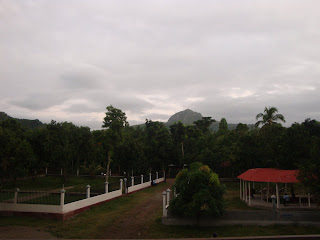 View from the roof of our compound in Tibo
After we finished the three day training session in Tibo, we drove to an area close to the Dominican border, called Ferrier. As we drove, I was struck by the amazing conditions of the roads and the fact that new ones were being built. I learned that the roads between Haiti and the DR had been improved to encourage commerce between the two countries. I also learned that the amazing roads from Cap Haitien to Tibo (close to Milot) were built so that cruise ships could dock close to Cap Haitien (but avoid the dirty city) and visitors could be bused to Milot to the Citadelle (A mountain fortress built back in the 1800s to help keep the newly-independent nation of Haiti safe from French invasions). I will be interested to see if either plan is successful or ever completed. Overall, I enjoyed my short visit to Ferrier and found it humorous that some of the Haitian children yelled "Gringo" instead of "Blan" when I ran by on my morning run.
 Although, I didn't get to spend much time in Cap Haitien, I found it interesting to see another larger city in Haiti besides Port-au-Prince. I was surprised to see how many "stores" there were in the town. The priest I was with said that a lot of things are shipped to the Northern part of Haiti from the States and are sold and/or stored in Cap Haitien before being transported to other areas of Haiti. He said that having so many little shops is actually a problem because fewer and fewer people actually live in the city, but just come there to work. He thought this was detrimental because despite the rich history of the city (it was the first capital of the Kingdom of Haiti and was the site of the final and defining battle of the Haitian Revolution), it is become less and less appealing for tourists.
I think one of my favorite parts of the trip was to getting to know Nancy, one of Gadyen Dlo's staff members. It was her first time ever on an airplane and she was just so proud and excited to have the opportunity to see other parts of her country. Sadly, I missed "Free Friday" at the border of the DR and Haiti. Every Friday it is free to cross the border as a means of stimulating trade between the two countries. Apparently, you can just see people walking back and forth. Nancy insisted on making time on Friday to cross the border and when she did, she started calling all her friends to tell them where she was and of course she had to have her picture taken so she could post it to facebook....
haha
 Overall, it was a great trip and I was grateful for my new experiences in Haiti. I do want to go back to further explore more of the historical areas in the North, including going to the Citadelle
.
I am working as the Monitoring and Evaluation Officer for two different organizations, The Children's Nutrition Program of Haiti (CNP) and Deep Springs International, both based in Léogâne, Haiti. Below I have written some specific information about each organization for those of you who are interested. During my time here (I am currently on a 6-month contract), I will be working on organizing both program's monitoring and evaluation systems, assisting with monthly reporting, finding ways to disseminate the work of the organizations (i.e. writing abstracts for conferences, etc), serving as research coordinator (overseeing student researchers and finding new organizations to partner with to conduct research involving our programs), and organizing many other specific projects for each organization. I am really excited and feel very blessed to have the opportunity to return to Haiti and work.
CNP (http://www.cnphaiti.org/) is the same organization I worked with when I was here in late July/early August conducting a needs assessment. They have worked in Haiti since 1998 and run a community-based management of acute malnutrition (CMAM) program. As part of their CMAM program, they run a stabilization center for children who are severely malnourished and have medical complications, provide outpatient care for children who are severely malnourished, and run supplementary feeding programs for children who are moderately malnourished. Their work is focused in the rural areas of the Leogane Commune and rely on the work of their community nutrition workers, monitrices.

 Monitrices are trained in point of use water treatment, family planning, STI prevention, danger signs for obstetrics, malaria, acute respiratory infections, diarrhea, infant and young child feeding practices and anthropometry. The monitrices screen children to monitor growth, identify and refer malnourished children to CNP's programs and implement breastfeeding support groups in their communities. The core program of CNP is called Positive Deviance Hearth (PD/Hearth). Positive deviance inquiries are done periodically in communities to learn from caregivers with healthy children, what specific care and feeding practices are being used that despite being located in a resource poor setting, allows their children to remain healthy while other children are not. For example, it might be that mothers of helathier children add coconut milk to the rice, or that even though the family only lights the cooking fire once a day, they divide the child's meals into three parts and feeds them three times a day instead of one, allowing the child to absorb more of the nutrients. The results of the PDIs are incorporated into CNP Hearths where caregivers of growth faltering or moderately malnourished children are invited to a 10-day Hearth session. Monitrices work with participants to make nutrient and calorie dense meals and educate the family on nutrition and healthy practices. CNP has expanded tremendously since the earthquake and are serving an invaluable role of educating, preventing and treating malnourished children.
Deep Springs International (http://deepspringsinternational.org/) runs a household chlorination program called Gadyen Dlo (“Water Guardian” in Haitian Kreyòl) with beneficiaries in the North, Northeast, Northwest, Southeast and Western region of Haiti. They focus on what is called point of use water treatment, meaning providing products to treat water so it is microbiologically safe to drink as well as providing safe storage for the water at the point of consumption, in the home. Even if homes have access to a clean water source, the water can become contaminated in the home. For example, despite collecting clean water, families may keep the water in an open container in the home with a cup to scoop the water out. A family member such as a child, may not have washed their hands before reaching into the bucket to scoop out the water and consequently contaminates the water used by the entire family.  Therefore, households in the Gadyen Dlo program utilize a 5 gallon bucket with a lid and tap and add a capful of locally produced sodium hypochlorite solution to water stored in the bucket. Gadyen Dlo has a network of water technicians (including the CNP monitrices) who prepare and sell the solution, educate new and existing users, visit users’ homes to test for chlorine residual, and maintain sales records. The GD program is sustainable by relying on the sales of the locally produced hypochlorite solution to cover portions of water technician salaries. They have done tremendous work not just in Leogane, but also in the communities where they are expanding throughout Haiti.

 First, meet the new CNP Country Director, Katherine Goulliart (we all call her Kat). She is a nurse midwife with years of experience here in Haiti. She worked at CNP as the maternal and newborn care coordinator before becoming the Country Director. She has a fascinating life story - from being a French Australian, to performing in the circus to living in refugee camps in Vietnam, there isn't much she has not done in her life. She has more energy than anyone I know. There isn't a day that goes by where we don't hear her laughing hysterically.
  Next, meet my friend Kara Telesmanick. Kara has worked for CNP for over 3 years. She is the Program Manager and has devoted so much time and effort to CNP, and has done tremendous work, especially following the earthquake. Before coming to CNP she did Peace Corps and lived in Bangladesh and also worked in South Africa. Kara is a vegan who is obsessed with dogs like me (her two Haitian dogs are now living with her parents in the states). She is an amazing dancer and is rarely found sitting down on our nights out dancing because all of the guys want to dance with her. Kara is laid back and easy to talk to, but also is totally fun to have around. I am going to miss her so much when she leaves to go to Medical School in December!!!

 Courtney Latta is a graduate of Elon who has worked for CNP for a year and a half. She is amazing and volunteered her time working as an intern before the earthquake and came back the earthquake to complete her internship. As of October 1st, she is officially an employee of CNP! She conducted all of the training sessions for the new monitrices (community nutrition workers) this summer and is going to be writing a training manual for our PD Hearth program.


 For people who live and work in the same house, we all get along surprisingly well. I am very lucky to be surrounded by so many unique and amazing people!!! They all definitely make my time here even more special!